Synopsis
My proposed title of this online documentary will be called Plastic Planet. It will explore the effects that plastic waste has on the environment as well as an in depth timeline showing of how plastic products are produced to where they inevitably end up. The aim of the project is to provide an educative experience to the user and within the medium of online documentary, it will use video content, photographs and digital collage.
Background Context
Plastic materials are being used increasingly more in manufacturing since their commercial development in the early to mid 20th century. Global plastic resin production reached 288 million metric tons in 2012, a 620% increase since 1975. The largest demand in the market for plastics is product packaging, materials designed for immediate disposal (Jambeck et al. 2015). Other products made from the material include everything from clothing fibres to electronic equipment. Plastic is a useful, inexpensive and versatile resource to use in manufacturing which explains its widespread usage. However, the problem is where is all this plastic ending up? Of all the plastic produced in the world, only around 9% has been recycled, 12% has been incinerated and the rest has ended up in landfills or polluted our natural environment and oceans (Mosbergen 2017).
This is a global issue and while it is not possible to cease using plastics completely currently, it is important to educate the public about the harmful ecological and environmental consequences. Changing patterns of behaviour is no easy feat, but through education it is easier to create gradual changes in the way people choose to buy and discard of plastic products. Plastic production is on a steady rise and over half of the plastic ever been produced has been made in the last 15 years alone (Mosbergen 2017), therefore it is a serious issue that needs action to be taken.
Purpose
The purpose of this online documentary is to educate and help facilitate change in people behaviours in regards to reliance on plastic products as well as their disposal. Plastic Planet will shed light on information about plastic manufacturing, its biodegradability and the environmental effects of improper disposal. This information will be presented in a timeline starting from a factory to where the products inevitably end up, whether it’s a landfill or in our oceans and its effect on our environment.
I will be sourcing my information from scholarly articles, statistics and interviews from researchers in order to give the project accuracy. At the end of the project users will have the option to click on a ‘resources’ link that will provide access to helpful websites for which they can use to educate themselves on plastic free living and live more sustainably.
Audience
The target audience for this online documentary will be people who are interested in making eco-friendly lifestyle choices. While it will be aim to be inclusive of all age demographics, there will be a specific focus on millennials who are more reliant on digital media across different platforms and are more inclined to share content amongst their friends. I have also targeted millennials because as early adopters of social trends and ways of thinking, they have the ability to influence their friends and family. According to a study on millennial behaviours, they are able to incite influence in older and younger generations creating an overarching change in societal behaviours (Fromm 2016, p.6). In terms of platforms, Plastic Planet will be produced for mobile phones, tablets as well as desktop browsers in order to avoid any form of alienation, particularly those who are not as digitally skilled or who only have access to one platform.
Social Media Integration
There will be various forms of social media integrated within the project. At the bottom of launch page screen will a navigation bar with the options ‘About’, ‘Resources’ and ‘Share’. Clicking on ‘Share’ will allow the user to share their engagement with the online documentary to Facebook, Instagram and Twitter and encourage family and friends to view it and share the documentary with others they know. I expect this to be the primary means of increasing viewership amongst our target audience and believe that this project is suited towards having a complimentary Facebook page. This benefit the project by allowing users to post feedback or any questions related to the project.
Interface Design
Plastic Planet will start with launch page which will then prompt then prompt the user to press ‘enter’. This will be followed by a short video that offers a cinematic introduction to demonstrate what the project is about. I want this to be cinematic and plan to use my own cinematography and accompaniment music to create something that will draw the user in. The home page will offer four options that detail the production of four different plastic products determined to be the most detrimental to our natural environment. These four choices will be plastic bags, straws, bottles and electrical appliances (mobile phones, computers etc.). Despite offering four pathways, the documentary will be somewhat linear in regards to the directions the user can choose to take after selecting one of the pathways in order to create a sense of cohesion. To add to the immersion and encourage exploration within each seen, the user interface will not be static and buttons will only be revealed when the audience moves the cursor across the screen. Only a ‘‘home’ button and a ‘back’ button will be included at the bottom of the screen to ensure the audience can return home or to the previous screen with ease.
Structure and Navigation
As said before, Plastic Planet will incorporate both linear and non-linear design elements. The user will be able to choose one four different pathways which will then take them through three main scenes based on their choice. Users will however be able to click and explore each scene to discover information based on the plastic material and the harmful effects that they have on the environment. While this many scenes might seem limited, each will have various interactive elements and which will bring up smaller scenes based on what the user has clicked on. While Plastic Planet will mainly rely on user-intuitive navigation, users will still progress through the documentaries four pathways in a linear fashion as it is presenting a timeline of the manufacturing process to the disposal of plastic products.
Feasibility
I believe that the completion of this project is highly feasible and attainable. In terms of production, I believe that my filmmaking and sound design skills are adequate enough to create my own content for the project. My main concern was finding site locations to photograph and film, however I believe that I could also use artistic liberties and create my own sets that would depict rubbish filled landscapes made using collage and found objects. I also would be making use of stock photos and film in order to depict the manufacturing processes of plastic production as I would not have access to view these facilities. Using copyrighted materials could be a possible issue so I would be need to source them carefully.
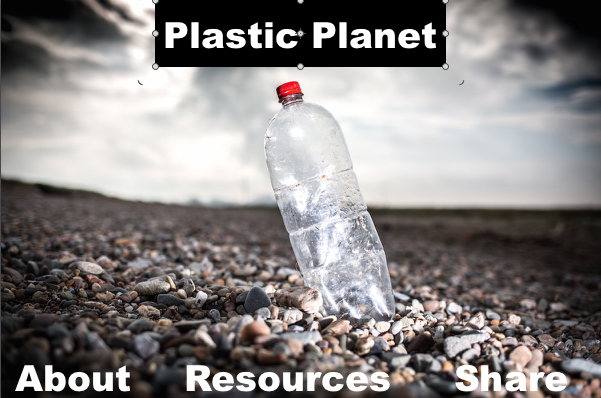
Landing Page
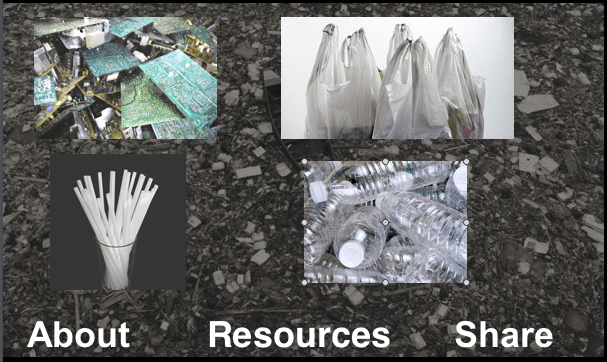
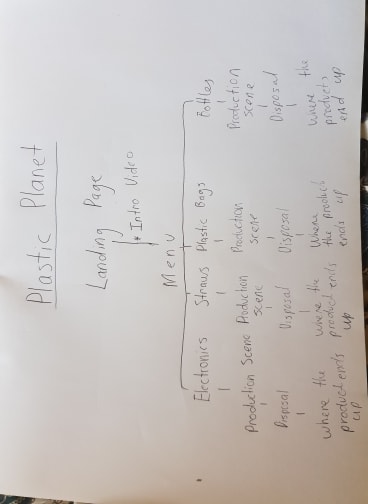
Wireframe
References
Jambeck, J. Geyer R, Wilcox, C., Seigler T. 2015, ‘Marine pollution. Plastic waste inputs from land into the ocean’, Science, vol.337, no. 6223, pp. 768-771.
Fromm, J. 2016, The Millennial Mindset: Quantifying the impact on consumer spend and brand preference across generations, Millennial Marketing, viewed 20th May 2019, <http://www.millennialmarketing.com/research-paper/the-millennial-mindset/>.
Mosbergen, D. 2017, ‘The Oceans Are Drowning In Plastic — And No One’s Paying Attention’, Huffington Post, viewed 20th May 2019, <https://www.huffingtonpost.com.au/entry/plastic-waste-oceans_n_58fed37be4b0c46f0781d426>.
 Plastic Planet